March 1, 2005
After a leisurely stroll around the streets bordering the bay and a visit to the internet cafe, we got on the road in the late morning. Belize is such a small country that it doesn't take very long to get anywhere, so about half way to Orange Walk Town, we stopped in a small village to have lunch. We turned down a side street and parked next to the town square. And immediately became the main attraction. Small children crowded around trying to see inside and the adults all came out of their houses. We figured we were the most interesting thing to happen all week.
After lunch we continued on toward Orange Walk and took the newly constructed by-pass around town. On the bypass we encountered many sugar cane trucks hauling Belize's main industry. We passed a sugar cane processing plant with what looked like a hundred trucks waiting to be admitted. Just around the corner we passed a barn that appeared to have four roofs, one above the other - pagoda style. We later learned that this was a rum distillery. Rum is also made from sugar cane.
Continuing on we came to the Tower Hill bridge where we stopped at Reyes and Sons to check on tours to the Lamanai Ruins. Securing a spot for the next morning, we continued our exploring. We decided to drive to the village of Progresso which is on a large lagoon. The road was 16 miles of hard-packed clay and very bumpy. In places where the clay was broken up, it was inches deep dust. By the time we reached Progresso we were covered in fine powder.
After visiting the beautiful lagoon, we continued down the road to a ferry across the river. The ferry wasn't on the map, nor was the road to get to it, so we were taking the word of the locals (who would know better anyway). Arriving at the river, we found there was in fact a ferry and it was made from an old barge, held 4-5 cars and is hand cranked.
| It was a fun experience getting onto and off of the narrow planking leading to and from the ferry. Other passengers gave the operator a break and took a turn cranking the ferry across the river. |

|
A couple of miles past the ferry, we came back into Corozal Town where we had begun our day. The road from Progresso surprisingly brought us back directly across the street from the campground!
March 2, 2005
Since we had ended our day back in Corozal Town we needed to get back to the bridge near Orange Walk to meet the boat tour to Lamanai. We left at about 7:15am and it only took an hour to reach Orange Walk. Since we had about 45 minutes to kill, we decided to drive through town. The inhabitants of Orange Walk work primarily in agriculture and industry. It was here that we encountered our first Mennonites. Most Belizean Mennonites migrated to Belize between 1958 and 1962, leaving behind persecution in their native countries. Through agreements with the Belize government, the Mennonites are allowed to practice their religion, use their language in locally controlled schools, organize their own financial institutions and be exempt from military service. In return the Mennonites have become the most productive farmers in Belize, contributing greatly to the production of eggs, poultry, dairy products and vegetables.
Our tour to the Lamanai Mayan Ruins included a slow tour down the various branches of the New River searching for and identifying new bird species for us. We saw trogans, snail kites, jacanas - which can walk across lily pads, and the largest flying bird in the Americas - the jabiru, a five foot tall stork. But one of the highlights of the ride were the high speed turns made by the boat captain on the tight twists of the river.
The ruins at Lamanai are located on the shore of the of a wide, shallow, forested lagoon. The National Institute of Culture and History has recently received numerous grants and have conducted additional digging at the ruins and built a small museum at the site. The highlights, beside just walking through the jungle, were the High Temple and the Mask Temple.
| The High Temple is a steep sided 33 meter (100 ft) tall pyramid, the tallest Pre-classic building in the region. The Mask Temple contained tombs and two eight foot tall stucco masks of a Mayan God, only one of which is visible as archaeologists reburied one to protect it from the environment. |
|
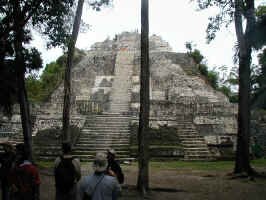
Unfortunately we didn't have time to explore the ruins of an 18th Century sugar mill or a church built on the ruins of another Mayan temple. But we did have time to enjoy a typical Belizean meal made by our guide's wife of baked chicken, rice and beans, pasta salad, fried plantains (bananas) and homemade salsa. Yum!
Looking for another camping location, our information only suggested the grassy lawn of a nearby restaurant. That didn't appeal to us, so we took a chance and decided to drive to the Crooked Tree Wildlife Sanctuary at the end of a dirt road about 15 miles away. When we arrived at the visitor's center we were told that we could either pay to camp on the front lawns of several homes in the village, or we could camp for free on the shore of the lagoon. Tough choice. We picked a nice spot just south of the the visitor's center where we were treated to a magnificent view across the lagoon and the hundreds of different birds feeding there.
March 3, 2005
While we were enjoying our morning coffee, a park ranger stopped by to visit. Turns out that he was one of the first rangers hired almost 17 yrs ago. He gave us his perspective on the interaction of the local people and the sanctuary. He has tried to educate the people about preserving the habitat, but he knows that it is very hard for them to change a way of living that has been passed down for generations. One of his ideas was to help the people change from raising free ranging cattle to raising cash animals like chickens and pigs. But to do this he would need funding to provide the people with money to buy the animals and plant animal feed. It sounded like a simple solution but in a developing country getting funding would be difficult. It was good to see that there were people like this ranger working to preserve the land while still helping the people live a traditional lifestyle.
One of the most enjoyable things we have found about Belize so far is the friendliness of the people. Everyone we have met has been helpful and likes to talk. One fellow who saw us driving around Progresso flagged us down and asked us if we needed help finding something or someone. We have already learned a lot about the people, their land and what they think about their government.
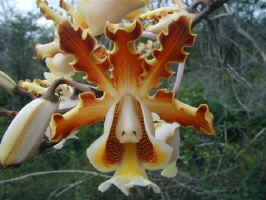
Driving to the far side of Crooked Tree we did a long hike out to a boardwalk built through a seasonal marsh (now dry). Our walk took us through 3 different vegetation zones, pine forest, savanna and marsh. Along the way we spotted more birds, beautiful orchids and flowering epiphytes.
Leaving the Sanctuary we made the decision to skip some of the smaller Mayan ruins as we will explore the magnificent ruins at Caracol soon. We drove down the road to the Community Baboon Sanctuary.
| This was a cooperative community effort by the World Wildlife Fund and land owners in nine communities to manage their land in ways that preserve the habitat of the black howler monkey, locally referred to as baboons. |
|
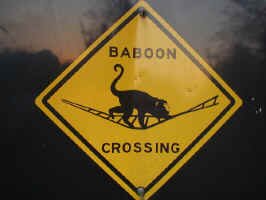
In fifteen years the number of monkeys has grown from less than one thousand to over four thousand. A second result was the growth of other native plant and animal species. The success of this program is now being studied by other countries in an attempt to adapt the concept to protecting their own endangered species without disturbing the people who live on the land. We found a camping spot at Russell's Bar in Bermudian Landing - one of the communities involved with the Sanctuary - and on the Belize River and were treated to the sights and sounds of the Howlers galore.
March 4, 2005
Camped on the grounds at the bar, which is also the home of the family, the children seem to have adopted us. They like to hang around and help us do any thing, but only watch as we do our laundry. In the morning, one of the boys brought over an arm load of cute, 3 week old puppies to show us, while his brother climbed a tree and brought us a couple of custard apples to eat. The custard apple is a mottled brown color and when you open it up, the inside is soft and tastes like ... custard. It is full of big black seeds that you suck on to get the custard off.
While our laundry dries, we'll fill up our water tank from the same source the family uses: the river. They use it directly, but we'll use our General Ecology water purifier to ensure a safe water supply. Then we'll head to Belize City where we have to try and get extra pages added to our passports before they fill up, otherwise we'll have to get replacements before we go onto South America this fall. If all goes well, we'll then get a water taxi out to Caye Caulker and spend the weekend snorkeling and diving along the second largest barrier reef system in the world.
