Sept 21-24, 2006
| We spent today running errands in Huaraz. Finally done by about 11:00, we hit the road. We stopped at what used to be the village of Yungay to pay our respects to the 18,000 people who perished there on May 31, 1970 when a huge landslide buried the town. An earthquake preceded the event, which caused an entire mountainside to come plunging down in what is referred to locally as an "aluvion". Without warning, the town and all of its inhabitants were buried. All that currently remains are tumbled walls from the church that was in the main square, four palm trees (3 stumps and one miraculously living tree), a crumpled bus and a hilltop cemetery. A lovely memorial park has been constructed as well as a reconstruction of the facade of the destroyed church. The crumpled bus has been left as it was found, twisted and mud filled. It was a very forceful and sobering reminder of the power of Mother Nature. We found the whole scene quite humbling. |
|

Continuing down the road, we stopped in the town of Caraz for a late lunch of ceviche and lomo saltado. Ceviche is raw fish, in this case, trout, that in this case had been locally grown. Lomo saltado is a mixture of beef, tomatoes and onions in a delicious sauce. We also enjoyed locally made cheese and locally grown corn. Yummy.
We had originally planned to continue on to Lago Paron but the weather started to decline so we decided to street camp in Caraz. We chose a small street on a plaza in front of a church and a hotel and received permission to park there. Seemingly a quiet spot, we were startled to hear the church bells ringing (on a Thursday night). Church-goers filed in while leaving their children outside to play in the plaza. The children decided that the Fuso was the perfect object of their affection and several times we had to shoo them away. But that wasn't the best part. A fireworks vendor set up shop in the plaza and displayed his wares on a regular basis. This wouldn't have been so bad if they had been the pretty type of fireworks, but they were the noise-maker type. Extremely annoying, especially since he seemed to have an endless supply. He did decide to move his rockets to the far side of the square after one zoomed over the Fuso and struck the church! Such an expert. The church service lasted for two hours and finally all of the children and the pyro left. That just left the barking dogs for us to deal with all night. Oh well, not every spot is perfect.
Getting up early the next morning (despite minimal sleep), we headed off toward Lago Paron. Surrounded by eight 5,000mt plus (18,000+ ft) peaks, this lake is considered one of the most spectacular in the area. But before you arrive at the lake, you have to survive the road. The first three miles of the 20 mile long drive are absolutely horrendous. A washed-out dirt road with only rocks holding it together. I'm not sure why we braved it but fortunately we did, because after the third mile, the road surface improved dramatically. It was still dirt, but it was graded and fairly smooth so our biggest obstacles became the low hanging tree branches and the tight hairpin turns, some even requiring 3 point turns. The views were quite spectacular however, with a major river rushing down the steep canyon. After 3-1/2 hours we finally made it to the top. That is an average of only 6 miles/hour!

|
|
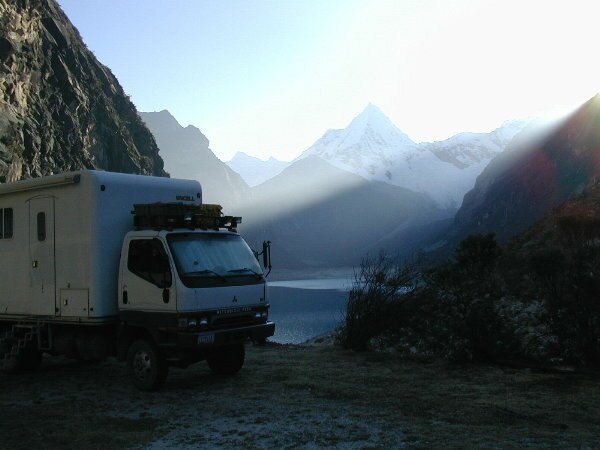
Once we arrived, we discovered that the parking options were quite limited. At the end of the road is the earthen dam which created the lake, an administrative office and an open area barely large enough to turn around. But behind the "no admittance" sign at the administrative office is a very large, grassy area that is the perfect camp spot. Even better, it has the best view of the lake and an area that is blocked by the incessant wind. Oh and did I mention that the lake is at almost 14,000 feet? It gets pretty chilly up there at night, especially with the wind. We asked the administrator is we could possibly park in the restricted zone (which was being used for absolutely nothing else) and was turned down flat. However the boss (jefe) would be there shortly if we wanted to ask him for permission. OK, lets go for a hike and talk to the jefe later.
The lake is set in a depression surrounded by the aforementioned peaks. By the time we arrived it was already after noon, and typically, most of the eight peaks were already shrouded in clouds. But there were a couple at the end of the lake that were quite spectacular. It made our hike to the end of lake very enjoyable, not to mention the waterfalls we could see along the way. We made sure to be completely prepared for the elements on our hike and typically when we started out it was so warm we were sweating and when we were returning, the chilly wind forced us to don ear protection and gloves.
By the time we returned, the jefe had arrived and was very pleased to let us park on his grass. We were able to barbecue in the lee of the mountain (in hats and gloves) and in the morning the clear view of all the peaks around the lake was absolutely stunning.
The Cordillera Blanca has 663 glaciers and the highest mountains in Peru. The highest mountain is 6768 mt/ 21,996 ft tall.
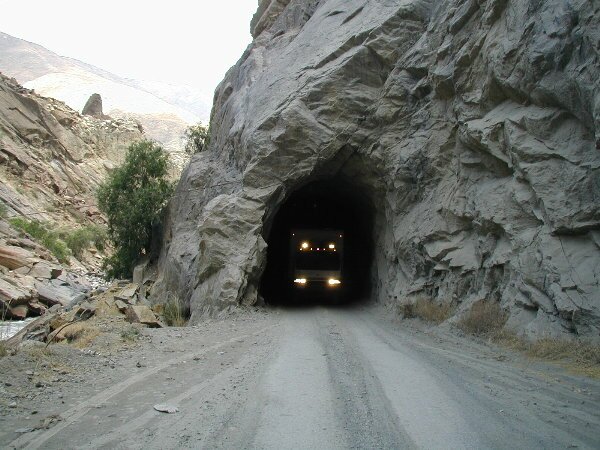
After enjoying the great view throughout the morning, we headed back down the mountain as we had a date with the infamous Cañon del Pato this afternoon. The Canyon is famous for its approximately 50 tunnels, 35 of which are in a stretch of only 12 miles. During a quick lunch stop, we heard a horn and looked out our window to see the big blue Mercedes camper of our friends Klaus and Dorothea that we had met on the way to Chavin several days before. As they were also heading in the same direction, we decided to travel through the canyon together.
The tunnels are carved right out of the mountain side and are not reinforced with concrete. The roadway is dirt and rock, slowing our travel to about 15 mph. The tunnels range from short singles, to very long singles, doubles even triple tunnels. Exiting one tunnel we found ourselves on a bridge over the river!
|

|
Although the canyon is only about 130km long (80 miles), we were only able to get about half way through it and made camp off the road for the night. The next day, after driving about 4 hours over rocks and dodging rock falls, we had gotten about half way down the road. Luckily, we found the rest of the road was paved - what a break on our beaten bodies. We made it down to the coast and headed north towards our next destination, Los Piramides del Sol y Luna - The Pyramids of the Sun and Moon.