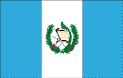
Grade
Level: 5
Guatemala
is a Central American country which is gathering its wits after 30 years
of a devastating civil war.
Its volatile topography is a mountainous and forested jumble of
volcanoes and jungles.
Take a quick glance at this fantastic country by visiting the
following website. Http://www.lonelyplanet.com.au/dest/cam/gua.htm#facts
LANGUAGE ARTS
Objectives:
Identify
the problems and challenges the people of Guatemala are
facing.
Understanding and comprehension can be monitored using the
worksheet attached.
Explore
current Peace Corp Projects
Explore
the cultural heritage of
Guatemala
Develop
ideas on how student can contribute to the
cause.
E-mail a
friend about how they can help.
Have the
students write paragraphs designed to promote tourism to Guatemala.
Encourage students to include
vivid language and colorful details to get their audience
interested.
Website:
The Peace
Corps in Guatemala
Objective:
Student
will learn about the living conditions, economy, natural resources, etc
about Guatemala. Write a composition comparing living in Guatemala to
living in the United States.
Lesson
Plan:Teacher
can read articles attached to spark interest in the two most recent
natural disasters in Guatemala.
Students
will take a self guided tour of the site
http://www.peacecorps.gov/kids/
After the students tour the Peace Corp site they need to decide on
a project the class can do to aid or increase the awareness of the need
for aid in the Country of Guatemala.
MATHEMATICS
(Like
most countries around the world, Guatemala uses the metric system.)
Objectives:
Have students use the scale on the map
of Guatemala to calculate the distances in kilometers between Guatemala
City and the following Guatemalan cities. Flores (488 kilometers), Tikal
(548 kilometers), Quezaltenango (206 kilometers), and Coban (528
kilometers).
Compare
distances of the cities above by creating a bar
graph.
Have
students research earthquakes/volcanoes around the world and create a
chart. Draw a line plot graph
of these activities. Discuss
relatedness.
SOCIAL STUDIES
Objectives:
(Current
Events) Over the years
Guatemala’s large population has been plagued by poverty. Have students gather news
information on Guatemala from newspaper, magazines, television, and
radio. Does the plight of
people in Guatemala seem to be getting better or worse? Based on the information the
students collected, they will give oral news reports on recent events in
Guatemala.
Research
the natural resources of Guatemala.
Reproduce a map of the country and illustrate the location of it’s
natural resources.
Website: www.muskingum.edu/~csun/lessonplan.html
SCIENCE
Objectives:
Part
I
Construct
models of the earth’s structure using materials of their
choice.
Simulate
the tectonic motion of the earth’s
plates.
Predict
and explore the outcome of “colliding
plates.”
Student
Activities:
1. Using an orange, each student will identify the three parts of the
Earth's cove, mantle, and crust.
2 . Instruct the students to use
any material of their choice to construct a model of the
Earth.
3. In a shallow
pan, have students cut pieces of
waxed paper so that they fit together like a jigsaw puzzle. Place the wax paper into the pan
and slowly pour some water into the pan. Have team observe the motion of
the wax paper. Explain that
the Earth’s plates float on the mantle in a similar manner. Ask what will happen if the plates
continue to float? Discuss
collision. Discuss formation
of folds and volcanic activity.
Part
II
- Correlate
the occurrence of volcanic activity to record seismic
activity.
- Produce a
multi-line graph of the two and arrive at a conclusion regarding their
occurrences.
- Trace,
chart, and plot global volcanic/seismic activity over a hundred year
period.
- Write a
scientific paper about their
findings.
Student
Activities:
Tracking
and Tracing Earthquakes and
Volcanoes
Terms:
Resources: Internet, National Geographics, Discover Science,
Encarta, Compton’s Encyclopedia, Newspaper
Archives.
Question: Is
there a relationship between locations that experience high seismic
activity and areas of high volcanic activity?
Agriculture is Guatemala’s most important industry.
Assign students the task of
reporting on the various steps in the production of one of the country’s
chief crops. They are as
follows: coffee, bananas, cotton, sugar cardamon, and corn.
GEOGRAPHY
Have students use maps found on the internet, atlases,
and other sources to locate information about the major geographic
features of Guatemala. They can identify major cities, rivers, lakes,
mountains, vegetation, and bordering countries and bodies of water.
Students can trace a map of Guatemala on poster board and draw symbols to
represent the geographic features.
1) What natural
disasters have occurred in Guatemala in the past 5
years?
2) What are
some of the projects the Peace Corp is involved
in?
3) Read about
the one of the projects and summarize it
below.
4) What
types of things do you think the people of Guatemala might need? Why?
5) Read
about one of Guatemala’s holidays and compare it to a similar holiday you
celebrate?
6) What countries border
Guatemala?
7) List 5
important facts about the country of Guatemala?
8) Click on
Food, Friends, and Fun (located on the side in the yellow zone) Pick a
topic that interests you and read about
it.
9) Using
the E-mail site send an E-mail postcard to a friend telling them how they
can help the people of Guatemala.
|| A Class Act
Home Page || Lesson
Plans || Resources
||