|
Chile
|
Lend a Helping Hand
You can help make the Virtual Classroom available to students by making a donation today.
|
| Origin of the name Chile |
There are various theories about the origin of the word Chile. According to one theory the Incas of Peru, who had failed to conquer the Araucanians, called the valley of the Aconcagua "Chili" by corruption of the name of a tribal chief ("cacique") called Tili, who ruled the area at the time of the Incan conquest. Another theory points to the similarity of the valley of the Aconcagua with that of the Casma Valley in Peru, where there was a town and valley named Chili. Other theories say Chile may derive its name from the indigenous Mapuche word chilli, which may mean "where the land ends" or "the deepest point of the Earth," or from the Aymara tchili meaning "snow"; another meaning attributed to chilli is the onomatopoeic cheele-cheele—the Mapuche imitation of a bird call.
(Wikipedia the free Encyclopedia) |
|
Symbols
|
Click on each link below to learn more about the symbols.
- Capital - Santiago
- National Bird -
-
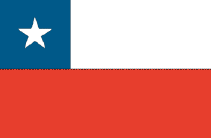
National Flag - white five-pointed star in the center representing a guide to progress and honor; blue symbolizes the sky, white is for the snow-covered Andes, and red stands for the blood spilled to achieve independence.
- National Anthem - The Himno Nacional de Chile is the National Anthem of Chile. It is also known as Canción Nacional (National Song).
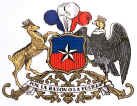
- Coat of Arms
- National Flower - The Copihue (Lapageria rosea), also known as the Chilean Bellflower and Chilean Glory Flower.
- Independence Day - February 12, 1818
- National Motto - Por la Razón o la Fuerza
(By right or might)
- National dance - The Cueca
|
|
Regions
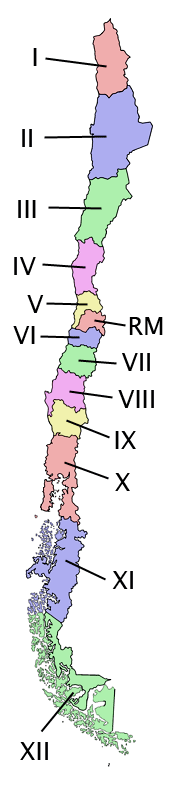
Chile consists of 13 Regions
|
 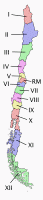
(Click on map to see it in detail)
Regions
Chile is divided into 13 regions, each of which is headed by an intendente appointed by the President. Every region is further divided into provinces with a Gobernador Provincial, also appointed by the President. Finally each province is divided into municipalities which are sometimes referred to as comunas, each with its own mayor, and councilors, known as consejales elected by their inhabitants.
Each region is designated by a name and a Roman numeral, assigned from north to south. In general, the Roman numeral is used, rather than the name. The only exception is the region where Santiago is situated, which is designated RM, that stands for Región Metropolitana, Metropolitan Region.
In 2005, the Chilean congress passed a reform to create two new regions, one in the north, around the city of Arica, and one in the south centered around Valdivia (aka Region of the Rivers). Being designated by numerals XIV and XV, both break the geographical numerical order from north to south. There is speculation that the numeral system will be dropped in favor of their formal names.
List of regions
| Key |
Name |
Spanish full |
Capital |
| I |
Tarapacá |
Región de Tarapacá |
Iquique |
| II |
Antofagasta |
Región de Antofagasta |
Antofagasta |
| III |
Atacama |
Región de Atacama |
Copiapo |
| IV |
Coquimbo |
Región de Coquimbo |
La Serena |
| V |
Valparaíso |
Región de Valparaíso |
Valparaiso |
| VI |
O'Higgins |
Región del Libertador General Bernardo O'Higgins |
Rancagua |
| VII |
Maule |
Región del Maule |
Talca |
| VIII |
Bío-Bío |
Región del Bío-Bío |
Concepcion |
| IX |
Araucanía |
Región de la Araucanía |
Temuco |
| X |
Los Lagos |
Región de Los Lagos |
Puerto Montt |
| XI |
Aysen* |
Región Aysen del General Carlos Ibáñez del Campo |
Coyhaique |
| XII |
Magallanes y la Antártica Chilena |
Región de Magallanes y de la Antártica Chilena |
Punta Arenas |
| RM |
Santiago Metropolitan Region |
Región Metropolitana de Santiago |
Santiago |
Sources: Wikipedia the free Encyclopedia
|
|
Languages
|
Spanish is the official language. |
|
Chilean History
|
Pre-Columbian
Human habitation of the Americas is generally accepted to have begun about 30,000 years ago. One of South America’s oldest archaeological sites at Monte Verde, near Puerto Montt is confirmed by radiocarbon dating to be more than 13,000 years old.
One of the earliest groups of people was the Chinchorro culture, fishermen who lived along the coast around 6,000 BC. These people developed a technique for mummifying their dead that was 2,000 years before the Egyptians. The San Pedro culture settled around San Pedro de Atacama around 500 BC and produced ceramics, textiles and objects from copper and stone. The Tihuanaco culture had powerful religious ties that influenced much of northern Chile and Peru for many centuries. They also developed a trading system which encouraged social structure.
In northern and central Chile, the El Molle and El Bato cultures developed around 300 AD and settled along the river valleys where they developed a system of irrigation to cultivate crops. Around 900 AD, the Aconcagua people emerged as the dominant culture in central Chile, building houses of branches and mud. Around 1000 AD the Diaguita culture appeared. It dominated the northern region over the next 500 years until the Spanish invasion. The Diaguitas lived in villages along the river valleys and their economy was based on agriculture, fishing, herding and metalworking.
In the south of Chile, the first group to begin cultivating crops around 600 AD is known as the Pitren culture. They lived in small family groups growing maize and potatoes. In 1000 AD the El Vergel people emerged and were the first to domesticate guanacos. Around 1300 AD the Mapuche arrived from Argentina and their lifestyle was based mainly on herding and farming. The far south of Chile was inhabited by groups known as the Selk’nam and the Tehuelche who hunted rheas and guanacos, and the Yamana and the Chono who fished and hunted seals, otters and birds.
In the 15th century, the great Inca civilization that had begun in Peru started expanding southward into Chile where its progress was halted by fierce opposition from the Mapuche. However the Inca built a magnificent system of roads before their influence and occupation were diluted by civil war and the arrival of the Spanish.
The Spanish Conquest
After Christopher Columbus landed in the Americas in 1492, Spain was eager to conquer all the lands that lay to the south. In 1532 Francisco Pizarro and Diego de Almagro landed on the coast of Peru where they found the Inca Empire embroiled in civil war. With advanced weaponry, the Spaniards were swiftly able to conquer the Inca, and Diego de Almagro was sent further south to conquer Chile. Suffering extreme hardship and deprivation, de Almagro was unsuccessful, but three years later Pedro de Valdivia set out with the same objective. In 1541 Valdivia officially founded Santiago de la Nueva Extremadura on the banks of the Rio Mapocho.
The new colony was isolated and unprofitable. The hoped-for large gold and silver deposits never materialized and the interest from the Crown was minimal. Thus most of the settlers lived by farming the land and survived by utilizing the encomienda system. This was a system by which the Spanish Crown awarded “grants” of indigenous people to the colonists in return for teaching them Spanish and about Christianity. While literally meaning “entrustment”, the system actually meant slavery for the native population. The encomienda system failed when large numbers of indigenous died rapidly from diseases brought from Europe. The Catholic Church also arrived to help “pacify” the native population. By indoctrinating them into Catholicism, they stripped away their indigenous beliefs and gave them less of a reason to revolt. The most influential religious order were the Jesuits who fed, clothed and housed their flocks and taught them Spanish and a trade, however the Jesuits were expelled in 1767 when the Spanish crown felt they had become too powerful.
In the late eighteenth century, things began to change with the reign of Charles III. The Spanish king relaxed trade restrictions, allowing the colonies to trade freely with each other and with Spain. This created a small mining boom as currency was needed to pay for imported items. The result was increased sense of progress and empowerment, especially for the criollos (people of mixed blood) who had been excluded from the highest colonial offices.
The criollos were given a sudden boost when Napoleon invaded Spain in 1808 and deposed the Spanish king. In Chile a six-man commission was elected to run the country and thoughts turned to independence. In 1811 Jose Miguel Carrera seized power and attempted to take power. His attempt ultimately failed, but it brought General Bernardo O’Higgins to the forefront. Teamed with Argentina’s Jose de San Martin, the two men liberated Chile by defeating troops loyal to the Spanish crown. Jose de San Martin went on to liberate Argentina and Bernardo O’Higgins was elected supreme director by Chile’s leading criollos.
The Republic
The transition from colony to republic was not a smooth one, and in the early years, Chile went through many changes of government. However in 1829 an authoritarian style government was ushered in which set the stage for a period of political stability. A new constitution was written by Diego Portales that would stand for 92 years. The growing self-confidence of the nation added to the political and social stability and trade began to take off. Wheat exports grew with demand and silver and copper mining boomed.
However, the late nineteenth century brought a worldwide recession and the fledgling economy came crashing down. War with Bolivia soon followed over who would control the vast nitrate-rich deposits in the Atacama Desert. Peru also entered the fray, but by the end of 1883, Chile had prevailed and extended its territory by 1/3 and the nitrate-rich pampas yielded enormous wealth and restored the national confidence.
Infighting continued within the government, however and the leaders seemed unaware of the social changes taking place around them. The enormous wealth from the nitrate industry had helped to create tremendous progress in industrialization and social diversification and a middle class emerged as did an urban working class. This working class had no political representation, however and took to striking to protest their terrible working conditions. The government violently put down these strikes, thus deteriorating the domestic situation. Then with the outbreak of World War I in 1914, the nitrate industry took a plunge, leaving thousands of people unemployed and causing inflation to soar.
After more political shenanigans, a new constitution was drawn up in 1925 which among other reforms, incorporated protective welfare measures. But again in 1929, the Wall Street crash sparked another worldwide depression leading to economic collapse and deep social unrest. The task of stabilizing the country fell to ex-president Arturo Alessandri who was re-elected in 1932.
Alessandri embraced a multi-party system that represented a wide spectrum of the population, however the system was dominated by the middle class- representing Radical Party. Succeeding presidents regenerated Chile’s economy by investing in state-sponsored companies. Nationalization of the copper industry allowed for social reforms such as the introduction of a minimum wage and improvements in education.
In 1970, Salvadore Allende was narrowly elected as Chile’s first socialist president. While half the country rejoiced, the other half feared a slide toward communism. In the short term, Allende’s government was both successful and popular with rising wages, economic growth and falling unemployment. However, government spending was exceeding income and the economic crisis was accelerated when the world copper price fell by 27%. Inflation began to rise, wages couldn’t keep up and food shortages became commonplace. Opposition to the government rose sharply. Strikes broke out and public unrest paralyzed the country.
On September 11, 1973, military tanks surrounded the presidential palace, marking the beginning of a military coup headed by General Augusto Pinochet. Congress was dissolved, opposition parties and trade unions were banned, military officers were sent in to take charge of universities and factories and thousands of Chileans fled the country as journalists, politicians, socialists, and so on were herded into the national football stadium where they were tortured and/or murdered.
Pinochet saw his role as rescuing Chile from years of chaos and he intended to do it by silencing those who opposed him and by adopting a free-market economy. This would involve reversing all of Allende’s policies and restructuring the government. He abolished all price controls, government-owned companies were privatized, government expenditure was slashed and attempts were made to increase investment and attract foreign capital. The immediate response was soaring unemployment, decreased wages, decreased industrial output and a poorer middle and lower class. By the late 1980’s the economy was showing signs of growth and inflation was decreasing but the wealth was unevenly distributed with 49% of the country’s wealth in the hands of only 10% of the population.
During this restructuring, thousands of people who disagreed with Pinochet’s policies were tortured and/or murdered. However the constitution that Pinochet had written up in 1980, guaranteed him power until 1988, at which time the public would be given the opportunity to accept or reject military rule. Despite the favorable economic climate, the public rejected Pinochet’s strong-arm tactics and Patricio Aylwin was elected to head a 17-party coalition called the Concertacion de los Partidos por la Democracia.
Chile's political climate has since remained stable, although there is still considerable tension between the military and the government concerning the human rights violations of the Pinochet era. For more information on Pinochet, read the BBC Pinochet Files.
On January 15, 2006, Chile elected its first female president, socialist Michelle Bachelet. A former political prisoner during Pinochet’s dictatorship, she made it clear that she intends to maintain the free-market polices that have turned Chile's economy into one of the strongest in the region. Source: Lonely Planet’s Chile & Easter Island by Carolyn Hubbard, Brigitte Barta and Jeff Davis 2003, The Rough Guide to Chile by Melissa Graham 2003, and Moon Handbooks Chile by Wayne Bernhardson 2002
|
|
Economy
|
Economy
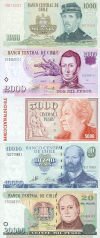
The Chilean economy has been growing steadily. Its major trade partners include the United States, the European Union, Japan, Argentina and Brazil. In recent years exports have diversified and the economy is no longer dependent on single traditional exports such as copper, however copper still represents 40% of the country’s exports.
Over the last few years, Chile has become the world’s second largest producer of fresh and processed salmon, fishmeal and fish oil. They are also the fifth largest exporter of wine worldwide and expect to increase production in the years to come.
Agriculture is also important as Chile produces half the winter-time fruit consumed in the northern hemisphere. Forest products are a rapidly growing sector, but at an unsustainable level and with questionable reforestation programs that use fast-growing exotic species such as Monterrey pine and eucalyptus.
Chile is an associate member of Mercosur (a free trade association of other S. American countries) and has free-trade agreements with Canada and the European Union.
Source: Lonely Planet’s Chile & Easter Island by Carolyn Hubbard, Brigitte Barta and Jeff Davis 2003, The Rough Guide to Chile by Melissa Graham 2003, and Moon Handbooks Chile by Wayne Bernhardson 2002
|
|
Geography and Climate
|
Geography & Climate
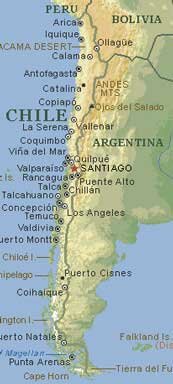
Chile stretches over 4,300 km (2,700 mi) along the southwestern coast of South America, a distance roughly the same as that from San Francisco to New York. At the same time, its width never exceeds 240 km (150 mi), making the country more than eighteen times longer than its widest point.
Chile's greatest geographic feature is the massive Andes, a mountain range that runs along the eastern edge of the country. This range contains more than fifty active volcanic peaks. The western border is the Pacific Ocean. In the north the land rises and becomes the Atacama Desert, one of the most inhospitable regions on earth. Through the center of Chile runs a narrow depression between the mountains and the sea called the central valley. This 500 mile long corridor is home to vineyards and farms in the north and forests and lakes in the south. In the south the land falls away, and the region fades into a maze of land and ocean that terminates in Chilean Patagonia. Chile's southern extremity is marked by Cape Horn, a treacherous headland surrounded by almost continuously storm-tossed seas and passable only through the Straits of Magellan.
Chile's climate is as diverse as its geography. Aside from the extreme climatic conditions of the Andes and the Atacama Desert, the country enjoys a comfortable temperate climate.
Earthquake
At 7:11 pm on May 22, 1960 Southern Chile suffered an earthquake that measured 8.6 (Richter Scale). Many of the coastal towns were devastated, some destroyed. In parts of Chiloe the shoreline dropped and the ocean reclaim the land - and the homes that were on it. The earthquake caused a Tsunami that swept fishermen away in Chile and which hit Hilo, Hawaii about 14 hours later - 10,000 miles away, then hit the coast of Japan causing further death and destruction.
The next day, the Puyehue Volcano erupted in the Chilean Lake District.
Weather
What is the weather like in the Region today? Follow this link to The Weather Underground for the forecast for the cities visited by our explorers. Or check out this satellite map from Weather.com.
Try converting the temperature in your town from Fahrenheit to Celsius.
Time
Most of South America is in the same time zone. What time is it in different cities in the region as compared to the time in your home town? Check this!
|
| Population, Ethnic Groups and Religion |
Population & Ethnic Groups
Chile’s population is nearing 16 million people, the majority of whom reside in the central valley, which is also the country’s agricultural region. The region includes the capital city of Santiago where almost a third of the country’s population lives.
Chile's population is composed predominantly of mestizos, who are descended from a cross between the Spanish colonizers and the indigenous people. The main surviving indigenous groups consist of the Aymara, who number approximately 20,000, in the north, and the Mapuche, who number roughly 1,000,000 and continue to inhabit the lake district. Chile is also home to a number of immigrant groups, including populations from virtually every European country. There are also significant numbers of Basques and Palestinians. Spanish is the country's official language, but Aymara and Mapuche are also spoken.
The vast majority of Chileans practice Catholicism, but Protestantism and to a lesser extent, Judaism, are also represented.
Source: www.geographia.com, Moon Handbooks Chile by Wayne Bernhardson 2002
|
| Fauna and Flora |
Flora
The northern coastal desert areas are nearly devoid of vegetation. The plants that can be found at higher elevations include Candelabra cactus and scrub forests. Further south, “rigid leaf” shrubs and trees appear increasing to temperate rainforests.
In the central region, the land has been deforested at a great rate due to dense population. South of the highly populated areas, the temperate rainforest has fared a little better with 95% of the fifty tree species being endemic, including the araucaria tree, also known as the monkey puzzle tree and the southern beeches. The alerce tree, a relative of the North America sequoia, can be seen around Puerto Montt.
In Chilean Patagonia there are evergreen and deciduous beeches along with dwarf shrubs and bogs.
Fauna
Because of Chile’s unique geography, one-third of its animals are not found anywhere else in the world. Many of these species are also at risk of extinction due to loss of habitat.
High in the altiplano in the north there are herds of llamas, alpacas, guanacos and the endangered vicuna, all members of the camelid family. The guanaco can also be found in Patagonia. Also in Patagonia can be found the endangered huemul, a small endemic deer species. Several species of rodents can be found in Chile including the endemic mountain vizcacha and the coastal chinchilla. Further south in the pampas and savannah can be found the mara or Patagonia hare. There are also feline species such as Geoffroy’s cat, the puma, the colo-colo and the guina.
Marine mammals include the southern sea lion, the southern fur seal, blue whales and dolphins. Reptiles include 6 species of non-venomous snakes, lizards and iguanas.
In the sparse northern regions, only a limited number of birds survive, including the Peruvian grey gull. The central region commonly seen birds include the Chilean parakeet the Chilean black croke and the giant hummingbird. Further south can be found birds such as kingfishers, woodpeckers and ducks. The forests support crested caracaras and other hawk species. In the mountains there are Andean condors, which are among the world’s largest birds. Also in the Andes, at remote saltwater lakes, there can be found Chilean flamingos, Andean flamingos and James’s flamingos. Further to the south can be found Darwin’s rheas which are similar to the ostrich. Coastal birds include Peruvian pelicans, Peruvian boobys and three types of penguins, Humboldt, Magellanic and rockhopper. More common birds include gulls, cormorants, shearwaters and terns.
|
| Environment |
From 1973 to 1990, Chilean economic policy, under the country's military government, relied heavily upon mining, forestry, and fishing for export. These industries developed without environmental oversight and put serious strains on Chile's forests, soils, and wildlife. In 1990, a democratically elected government took power, and the country's economy began to grow quickly.
Chile's presidents have exhibited a concern for the environment, and has demonstrated support for conservation efforts and fuel diversification.
Chile has signed and ratified the United Nations Framework Convention on Climate Change as a non-Annex I country, and is therefore not obligated to reduce its emissions of greenhouse gases. Chile also is a signatory to the more recent Kyoto Protocol and is party to several other international environmental treaties, such as the Montreal Protocol and the Convention limiting the movement of hazardous wastes.
Chile's rapidly growing economy has come at a significant cost to the environment. With total energy demand expected to continue to grow by 7% annually, and air pollution in Santiago already reaching critical levels, the continuing evolution of Chile's fuel mix away from petroleum and coal and towards natural gas and hydroelectric generation is key to the country's environmental future. The challenge in the years ahead will be to find a balance between meeting Chile's growing energy needs and strengthening the country's commitment to environmental protection.
Fish Farming
Open-netcage fish farming is a controversial practice and has raised serious environmental concerns around the world. Chile is a large supplier of farm raised fish such as salmon.
There are several problems associated with open-netcage salmon farming:
- Sewage from farms pollutes surrounding waters.
- Drugs, including antibiotics, are required to keep farmed fish healthy.
- Escapes of farmed fish (alien species) threaten native wild fish.
- Net loss: Farmed fish are fed pellets made from other fish - depleting other fish species on a global scale.
For more information on this topic follow the link to the David Suzuki Foundation below.
Source: Energy Information Administration, The David Suzuki Foundation
|
Sources: Wikipedia the free Encyclopedia, Lonely Planet’s Chile & Easter Island by Carolyn Hubbard, Brigitte Barta and Jeff Davis 2003, The Rough Guide to Chile by Melissa Graham 2003, and Moon Handbooks Chile by Wayne Bernhardson 2002, Energy Information Administration, The David Suzuki Foundation and www.geographia.com
Kim and Don Greene, Contributors; publication date April 6, 2006
|